Canadian Wiggler — Hollow Brass Lures since 1945

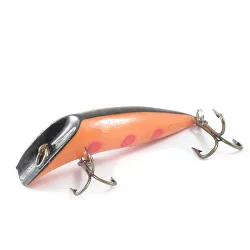
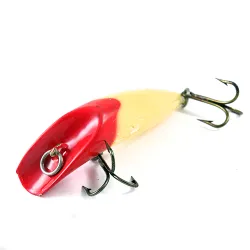
Lindquist Bros. Bait Co. Ltd., based in Tecumseh and Windsor, Ontario, has been producing the Canadian Wiggler since 1945. This brand represents a distinct chapter in North American angling history, defined by the concept of the World’s Only Hollow Brass Lure. Unlike common wooden or plastic wobblers, these lures utilize a hollow metal body, which provides specific acoustic properties and significant resistance to the teeth of large predators such as muskellunge or pike.
Hand-assembled and tank-tested production. Every lure is assembled by hand and undergoes individual tank testing to ensure stable action straight from the packaging. This focus on consistency is a hallmark of the company's approach to manufacturing, emphasizing durability and mechanical reliability.
Systematic approach to lure selection. The manufacturer utilizes a structured alphanumeric coding system where letters indicate the series, size, and type, while the numerical suffix identifies the specific color pattern. Among others, the range includes the CW, CWR, CWS, and CWH series designed for depths between 8 and 10 feet. For deeper presentations, the CWJ, MJ, and MJR series are capable of reaching depths up to 16 feet, making them suitable for trolling applications.
Variations for different water columns. The catalog also contains mid-range and shallow models such as the M, MR, MS, S, SR, STH, and J series, covering the 2 to 12-foot range. For topwater or shallow-water presentations, the SF and MF surface models are used. A notable feature in the assortment is the jointed version, which consists of two segments connected by a hinge to produce a serpentine action simulating a wounded baitfish.
Color palettes and visual markers. The decorative schemes are documented through detailed inserts. Patterns include options like #21 (Fluorescent Red), #22 (Blue Mackerel), and #23 (Black back with white-silver belly). Specific codes, such as CWR153, denote configurations like Black Shad with eyes. Visually, these lures often feature prominent eyes and high-contrast accents, such as red spots on a yellow background, reflecting mid-20th-century Canadian lure design aesthetics.
Versatility in angling techniques. These brass lures are designed for various methods, including casting, spinning, trolling, and hand lining. They are used to target a broad spectrum of freshwater species: walleye, pike, salmon, trout, and musky. For trolling, technical recommendations suggest a speed range of 1.5 to 4 miles per hour.
Packaging and regulatory evolution. Over the decades, the presentation has evolved from traditional cardboard boxes containing paper instruction leaflets to contemporary blister packs on cardboard backings. Later packaging also includes lead warnings in accordance with California standards, reflecting the brand's international distribution and compliance with environmental regulations of later periods.