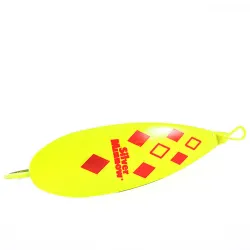
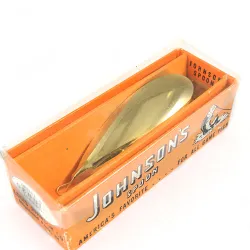
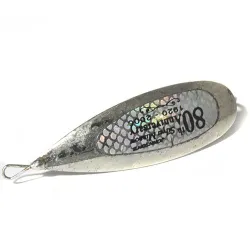
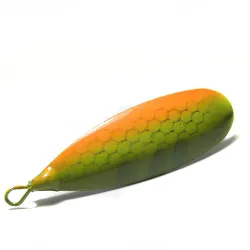
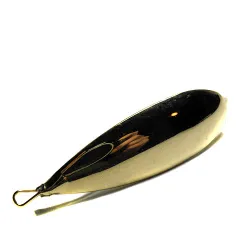
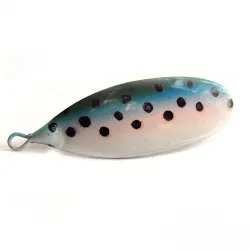
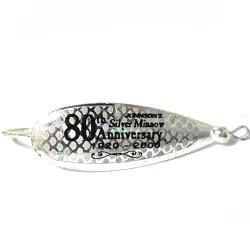
Johnson Silver Minnow
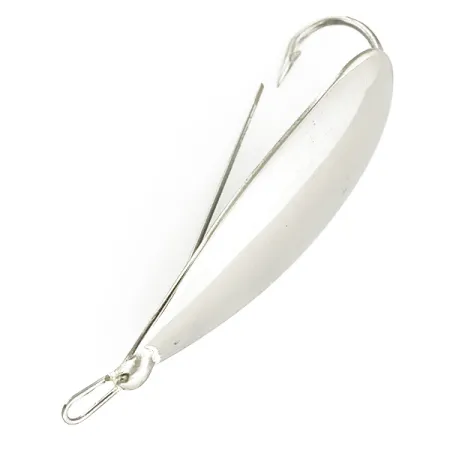
Among weedless spoons, the Johnson Silver Minnow stands out as a lure built specifically for choked, weedy water. Back in 1920, Louis Johnson set out to solve the problem of fishing overgrown lakes and came up with a spoon that would ride through vegetation without constantly fouling the hook. He mounted a protected hook on a spoon made from a copper–zinc alloy and then plated it with real silver. The alloy body is intentionally thicker in the middle, so on the retrieve the lure rocks from side to side yet keeps the hook riding point‑up, which helps it slip through grass and weeds instead of hanging up.
The trademark of this spoon is its controlled wobble and the way it throws light. In the water the Silver Minnow swings through an arc of about 270 degrees, giving a wide, rolling action that sends flashes off the silver plating. Those flashes are directed mostly downward and to the sides, into the sectors from which fish most often ambush prey. The rocking motion not only adds visual appeal but also eliminates the need for swivels to prevent line twist, something spoons without this balance often require.
Real silver on a fishing spoon was a genuine step aside from the usual plated finishes of its time. Instead of chrome or polished steel, the Silver Minnow uses true silver plating, which produces a whiter, brighter flash underwater. This finish, combined with the broad wobble, creates a consistent flicker that can be seen from different angles as the spoon swings. The use of actual silver also sets this design apart from most other metal lures that rely on more conventional coatings.
The Silver Minnow works naked, but it also lends itself well to trailers. It can be fished on its own or paired with an attractor to add bulk, movement, or color. The balance of the spoon and the position of the hook are such that the action does not break down when a trailer is added, which is not always the case with spoons. A common setup uses a strip of pork rind in red‑and‑white or yellow‑and‑white. Those color patterns suggest the look of red gills on a wounded baitfish, which can act as a visual cue for predators that are tuned to pick off slow or injured prey.
Production has shifted over the years, and that matters to collectors. Today the Johnson company manufactures these spoons in China, but the examples in this particular collection were produced earlier in the United States. Within a tackle box, that detail turns them from everyday hardware into older, U.S.‑made pieces that many anglers would regard as small rarities.