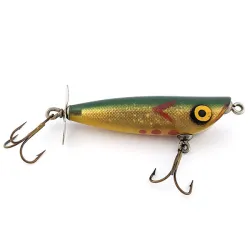
Dalton Special

Dalton Special: The Lure That Conquered the Surface
The story of the Dalton Special didn’t begin in a factory, but in the workshop of a talented Florida angler named Philip Dalton. In the late 1930s, Dalton was looking for a way to trigger aggressive surface strikes in the thick, grassy waters of the South.
The Birth of a Legend In 1939, Philip Dalton officially introduced his creation. The Dalton Special was unlike any other lure of its time. Its unique design—a pointed nose transitioning into a wider body with a flat-cut face—produced an unmistakable action. On a twitch, the lure wouldn't just splash; it would dive sharply, mimicking a wounded baitfish trying to escape, before slowly floating back to the surface.
Key Facts:
Founder: Philip Dalton.
Origin: Tampa, Florida, USA.
Industry Giants: The lure’s success was so massive that production rights were later acquired by the Shakespeare Company and eventually James Heddon's Sons, making it a global phenomenon.
Why Anglers Swear by It:
Versatility: Pros knew the Dalton Special could be worked with short, sharp snaps like a popper or long, steady pulls. Both techniques created powerful acoustic vibrations.
Materials: The original Tampa models were carved from cedar, giving them a "lively" buoyancy. While later plastic versions by Shakespeare and Heddon were effective, collectors still hunt for the original wooden pieces.
Performance: In Florida, it became the "gold standard" for trophy bass. There was a common saying: "If they won't hit a Dalton Special, there's no bass in the water."